
Views: 0 Author: Site Editor Publish Time: 2026-04-08 Origin: Site


Why is Nylon Rope used in so many tough jobs? It stays strong, flexible, and practical in daily work. In this article, you will learn what Nylon Rope is, how it is used, and why it remains a reliable choice for many applications.
Nylon rope is not a natural fiber rope. It is made from man-made polyamide material, so its structure is more controlled and more consistent in use. That is one reason it is common in marine, transport,and utility applications. It is known for handling tension well, bending easily, and staying practical in jobs that need both strength and easy handling.
New Coast Rope also extends this material into application-based products such as nylon dock lines, nylon anchor lines, and nylon kinetic recovery ropes. This shows that nylon rope is not just a single product type. It is a broad category that can be adapted to different working needs.
The main raw material is nylon, which belongs to the polyamide family. Unlike natural rope made from plant fibers, nylon rope is produced from synthetic material. This gives it a more uniform structure and helps keep performance more consistent from one use to the next.
The material is first processed into fibers and yarns, then formed into different rope constructions. That is why nylon rope can appear in twisted and braided forms.
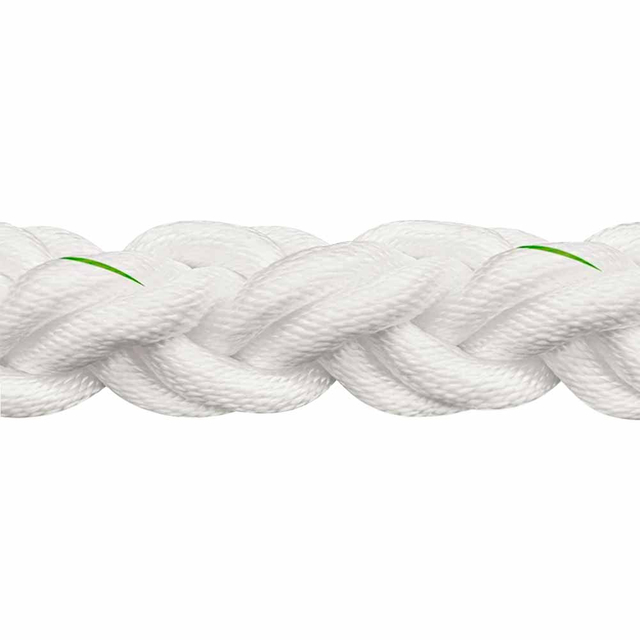
When people talk about rope strength, they usually mean how much pulling force the rope can take before it fails. That is the basic idea of tensile strength. In simple terms, it tells us how well a rope holds up when a load keeps pulling on it. Nylon Rope is known for this because its synthetic fiber structure helps it stay strong in demanding jobs.
This is one reason it is often used in pulling, lifting support, mooring, and towing tasks. It handles force better than many lighter-duty rope materials and stays useful in situations where both strength and flexibility matter.
| Application Type | Why Strength Matters | How Nylon Rope Helps |
|---|---|---|
| Pulling | The rope stays under direct tension | It handles force more reliably |
| Mooring | Loads shift due to movement and water | It supports holding power well |
| Towing | Force can build quickly during use | It offers dependable load support |
One of the best-known benefits of Nylon Rope is its ability to stretch under load. This elasticity is not a weakness. In many cases, it is a real advantage. When force comes suddenly, the rope can absorb part of that energy instead of passing all of it directly into the load, boat, vehicle, or connection point. That is why nylon is often chosen for jobs where impact and motion are common.
Docking: It helps soften sudden movement when a boat pulls against the line. That makes the rope more suitable for active marine conditions.
Anchoring: It responds better when force changes due to wind or waves. This helps reduce sharp load transfer.
Recovery: It works well in dynamic pulling jobs where sudden tension may appear. Controlled stretch can make those moments easier to manage.
Yes, Nylon Rope is also valued for its resistance to wear in repeated-use environments. Ropes are rarely used only once. They are pulled, tied, dragged, coiled, and handled again and again. Because of that, abrasion resistance becomes an important feature. Nylon rope performs well here, which is why it stays useful in marine, industrial, and outdoor tasks.
It also handles many working-condition challenges better than basic rope materials. New Coast Rope describes its nylon and other rope products around durability, anti-wear performance, and corrosion resistance, and it supports this positioning through manufacturing and testing capability. The company highlights imported production equipment and 150-ton and 500-ton tensile testing machines, which helps strengthen the quality story in a smooth way.
Marine work is one of the most common uses for Nylon Rope. It is often used for dock lines, anchor lines, and mooring ropes because it can handle movement and changing tension more smoothly than many basic rope materials. Boats do not stay still for long. Waves, wind, and current keep adding force, so a rope used in this setting needs both strength and controlled stretch.
New Coast Rope naturally fits this kind of application. Its product range includes nylon ropes designed for docking and anchoring, which shows how closely nylon is linked to marine use. In these jobs, the rope is expected to stay strong, absorb shock, and remain workable during tying and release. Those are practical reasons why nylon stays popular around boats, ports, and general marine handling.
Dock lines: They help secure a boat at the dock. Nylon rope is useful here because it can absorb sudden force when the boat moves.
Anchor lines: They connect the anchor to the boat during holding. Its flexibility helps reduce shock from waves and shifting pull.
Mooring ropes: They are used when a vessel needs stable positioning. Strong rope matters here, and easy handling matters too.
Yes, Nylon Rope is widely used for towing and recovery work. In these situations, the rope often faces a sudden pulling force instead of a slow, steady load. That is where nylon performs well. Its elasticity helps it respond to dynamic tension more smoothly, which is useful when moving vehicles, equipment, or other heavy loads.
This is also why nylon appears in kinetic recovery rope products. In off-road recovery or heavy pulling tasks, the rope may need to stretch under force and then help transfer energy in a more controlled way. That makes it a useful option for recovery jobs where strength alone is not enough. The rope also needs to stay workable during setup, connection, and repeated use.
Towing work: It is used to pull vehicles, small equipment, or loads across short distances. Good strength and flexibility both matter here.
Recovery use: It is common in vehicle recovery and heavy-duty pulling tasks. Controlled stretch helps during sudden force.
General pulling tasks: It can also help in farm, workshop, or transport settings. The rope stays useful in more than one kind of job.
Nylon Rope is also suitable for many construction and industrial tasks. It is often used for lifting support, pulling, load handling, and general utility work around active job sites. These environments are not gentle. Ropes may be dragged, tied, bent, or used again and again during daily operation, so durability and flexibility both matter.
In industrial use, rope selection depends on the task, not just the material name. Some jobs need a rope that is easy to handle and quick to tie. Others need stronger support for pulling or guiding loads. Nylon rope works well in many of these settings because it offers a balanced mix of strength, wear resistance, and practical handling. That broad usefulness is one reason it stays relevant in workshops, warehouses, transport work, and general site operations.
Lifting support: It can assist in lifting-related tasks where flexible rope handling is needed. Proper load planning is still important.
Pulling and positioning: It helps move or guide materials during work. It is useful when repeated tension is involved.
General utility: It works well for tying, securing, and handling loads on busy sites. That makes it a practical work rope.
Beyond heavy work, Nylon Rope is also useful in outdoor and general utility tasks. It can be used for camping, bundling, securing gear, household jobs, and farm work. This wider use matters because not every rope application is industrial. Many people need a rope that is simple to use, strong enough for daily tasks, and flexible enough to store and handle without trouble.
That versatility is part of nylon rope’s appeal. It works in more serious settings, but it also adapts well to lighter jobs. A rope used for camping gear may also be useful for tying equipment in storage. A rope kept in a workshop may also help around a garden or farm. That kind of range makes nylon rope popular far beyond marine or industrial fields.
Camping: It can help secure tarps, tie gear, or support shelter setup. Easy handling makes it practical outdoors.
Bundling: It is useful for grouping tools, materials, or supplies. Flexibility helps during tying and release.
Securing gear: It can hold items during storage or transport. Good strength adds confidence in daily use.
Household and farm utility: It supports many routine tasks, from tying items to general outdoor work. That makes it a dependable all-around rope.
The first thing to check is the application type. Ask what the rope will actually do. It may be used for mooring, towing, securing equipment, or general utility work. Once the job is clear, it becomes easier to judge the rest. This approach is more practical than choosing a rope just because it looks affordable.
The next point is the working load need. A rope should match the force it will face during normal use. Then look at rope diameter, since a thicker rope often supports heavier work and gives a different handling feel. After that, consider rope construction. Twisted and braided nylon ropes do not behave the same way, so the structure affects both performance and ease of use.
Rope construction matters because it changes how Nylon Rope works in real situations. Two nylon ropes may use the same material, yet they can still feel very different. One may suit a basic utility task, while another may be better for smoother handling or more demanding use. That is why construction should always be matched to the job.
In general, 3 strand nylon rope is a good fit for general utility work and many basic marine tasks. It has a familiar structure and works well in straightforward applications. Braided nylon rope or double braided nylon rope is often chosen when smoother handling and more refined performance are needed. These options can feel easier to control and more comfortable in repeated use.
3 strand nylon rope: It works well for everyday utility and basic marine applications. It is a practical choice when a simple structure is enough.
Braided nylon rope: It offers a smoother surface and often feels easier to manage. It suits jobs where handling matters more.
Double braided nylon rope: It is often used in higher-performance situations. It gives a balanced mix of strength and easier control.
Task-based choice: There is no single best option for every need. The right construction depends on the actual use.
A good material choice should include both advantages and limits. Nylon Rope is popular for clear reasons, but it is not ideal for every single application. A balanced view helps make the material easier to understand and helps avoid the wrong choice.
Its main strengths are strength, flexibility, abrasion resistance, and shock absorption. These features make it useful in pulling, docking, anchoring, towing, and repeated-use work. At the same time, nylon also has some limits. It can absorb water, and its stretch may not suit jobs that need very low elongation. Performance can also change depending on the environment and the way it is used.
| Type | Aspect | Description |
|---|---|---|
| Advantage | Strength | It handles pulling force well and supports many demanding tasks. This is one of the main reasons it is widely used. |
| Flexibility | It stays easy to handle during tying, coiling, and general operation. That makes daily use more convenient. | |
| Abrasion resistance | It performs better in repeated-contact situations. This helps in marine, industrial, and utility settings. | |
| Shock absorption | Its stretch helps reduce sudden load stress. This is especially useful in docking, towing, and recovery work. | |
| Limitation | Water absorption | Nylon can take in moisture during use. This may affect how it behaves in some conditions. |
| Stretch limits | Its elasticity is useful in dynamic situations, but less suitable where low stretch is preferred. | |
| Environmental variation | Long-term performance can differ depending on storage, exposure, and working conditions. |
Nylon rope is valued for strength, flexibility, and shock absorption in marine, towing, industrial, and daily utility work. New Coast Rope adds value through multiple nylon rope constructions, application-based products, and custom service, helping users choose practical rope solutions for different working needs.
A: Nylon Rope is a synthetic rope made from polyamide fibers for strong, flexible use.
A: Nylon Rope is used for mooring, towing, recovery, camping, and general utility tasks.
A: It absorbs shock well and handles movement better in docking and anchoring.
A: Check the use, load, diameter, and construction before choosing.
A: Yes. It absorbs water, and its stretch may not suit every job.


